








Some websites are exactly what their name suggests. Others carry a name from an earlier chapter of their life, long after the story has moved on. BlessingTide belongs firmly in the second group, and that single fact explains almost everything a visitor needs to know about it.
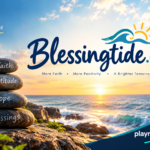
The name itself is gentle and hopeful. It joins the idea of a blessing with the idea of a tide, suggesting something good that arrives steadily and without effort. The site’s own tagline reinforces this, promising a touch of grace in every blessing. Anyone reading that would reasonably expect prayers, encouragement, and quiet daily reflection. What they actually find is something else entirely, and the distance between the two is worth understanding properly.
A Website With Two Different Identities
Open the site and you will see traces of its original purpose still sitting in plain view. The footer welcomes visitors to a warm space where positivity flows, gratitude grows, and uplifting words are meant to lift the spirit each day. The category list still holds sections built for that mission, including one for physical blessings and another devoted to Friday blessings. These are not decorative. They were built by someone who genuinely intended to publish devotional writing.
Yet the site’s own description of itself, written on its introduction page, tells a much wider story. There it presents itself as a general publishing platform covering news, guides, explainers, celebrity profiles, technology, lifestyle, health education, relationships, and entertainment. That is not a description of a devotional blog. It is a description of a website that will publish almost anything, and it was clearly written after the original mission had already faded.
What the Homepage Looks Like Today
The clearest evidence sits on the front page. Recent articles include a guide to choosing a supplier of solar inverters for distribution, a three-month roadmap for becoming visible inside artificial intelligence search tools, an introduction to raised garden planter boxes, advice on selecting a marketing agency, study strategies for students in their eleventh year of school, information about emergency plumbing services, an explanation of functional fitness training, guidance on managing short-term holiday rentals, and an overview of professional skin examinations.
Sitting above all of them is an article written entirely in Uzbek about modern cars and city driving, published without translation. For a website that presents itself in English to an English-speaking audience, that single post says more than any analysis could. It shows that content is being added to the site for reasons that have nothing to do with the people reading it.
The Australian Connection Nobody Mentions
Look closely at the service articles and a geographic pattern emerges. The plumbing piece concerns the Northern Beaches. The holiday rental article concerns Sydney. The skin examination article concerns Melbourne. These are Australian places, and they appear because Australian businesses wanted articles mentioning them.
This matters because a number of other websites have written descriptions of BlessingTide claiming it focuses on American households, American family routines, and American holiday traditions such as Thanksgiving. Nothing on the site supports this. There is no separate American edition, no American section, and no American focus of any kind. Those descriptions appear to have been written by people who looked at the name and imagined the rest without ever opening the website. Anyone relying on them would be repeating something invented.
One Writer, Many Subjects
Almost every recent article carries the same single name as its author. That same name appears above the piece on solar equipment, the piece on tutoring, the piece on plumbing, the piece on skin health, and the piece on marketing agencies.
No individual possesses genuine expertise across that range. Solar hardware, secondary education, plumbing, dermatology, and digital marketing are separate fields requiring separate training and separate experience. When one name sits above all of them, it usually means the name is a house label applied to whatever arrives, rather than a real writer with real knowledge of each subject. This does not make the articles false. It does mean the author’s name offers no reassurance about accuracy, which is normally one of the first things a careful reader looks for.
How the Site Pays for Itself
The website carries advertising, which is completely ordinary and reflects nothing negative about any publisher. Countless respected publications rely on the same arrangement. What advertising does create, however, is a quiet pressure toward volume, because more articles mean more opportunities to earn.
Combine that with the strong likelihood that businesses are paying to have their articles and mentions placed on the site, and you get a publishing model built around quantity. In such a model, the incentive is to publish steadily rather than to check carefully. Nothing about this is illegal or hidden, but it does shape what the site produces, and readers benefit from understanding that shape before they trust what they read.
The Pages That Build Trust, and the Ones That Don’t
In fairness, the site does several things properly. It publishes an introduction page, a disclaimer, a contact page, and a privacy policy, and it maintains a working index of its content. Plenty of similar websites skip all of this, so its presence deserves credit.
Other details undercut that impression. The footer displays buttons for several social media platforms, but each one simply returns the visitor to the website’s own homepage rather than leading to a genuine profile. There is no verifiable information about who owns or edits the site, no biography for the person credited as author, and no published policy explaining how corrections are handled when something turns out to be wrong. The structure of a trustworthy publication is there. The substance behind it is not.
Why So Many Other Websites Are Writing About This One
An unusual thing has happened around this domain. Several unrelated websites have published near-identical articles explaining what BlessingTide is, most of them appearing within the same short period. One even uses a nearly identical domain name, which makes confusion easy.
These articles broadly repeat each other, and several contain claims that do not match the website at all. This tends to happen when a domain name becomes the subject of automated content production rather than genuine interest. The practical consequence for a reader is simple. Descriptions of this website found elsewhere should be treated with the same caution as the website itself, and anyone wanting the truth should open the site and look directly.
Reading the Health and Money Articles Carefully
Some subjects carry real consequences when the information is wrong. Health, money, legal matters, and personal safety all fall into this group. The site publishes health material, including articles about exercise programmes and professional skin examinations, and skin examination in particular touches on cancer detection.
There is no sign that any medical professional reviews this material before publication. That is not unusual for a general website, but it does mean such articles should never be treated as guidance to act upon. They can raise a question worth asking, and that is a genuine value. The answer should come from a doctor, a qualified adviser, or an established medical institution rather than from a general blog that also writes about garden planters and rental properties.
What to Do If Someone Offers You a Spot on the Site
Many people encounter this website not as readers but as business owners approached with an offer to place an article there. The decision deserves thought rather than a quick yes.
A mention on a website with no clear subject, no verified authorship, and no visible editorial standards carries far less weight than it might appear to. Search engines have grown steadily better at recognising websites that publish across unconnected subjects for commercial reasons. Before agreeing, it is worth asking whether the article will be clearly marked as paid, how long it will remain online, and who controls it afterwards. Vague answers to any of those questions tell you a great deal. In many cases, the same money spent on strong original content for your own website will serve you better and keep serving you longer.
Conclusion
BlessingTide is not dangerous, and it is not a fraud. It is an ordinary website that began with a sincere purpose, gathered a small amount of standing, and then turned that standing into a commercial arrangement. The devotional branding survives because nobody removed it, not because it still describes what happens there.
For a reader, the sensible approach is straightforward. Enjoy the encouraging material for what it is, since there is nothing to verify in a kind word. Treat everything factual as a starting point and confirm it somewhere reliable before acting. And if you came looking for an American version of this website, know that none exists, whatever other pages may claim. Understanding a website honestly is always more useful than trusting the promise in its name.