






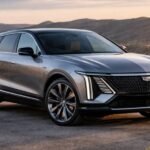



Anyone who has spent a week behind the wheel of a Cadillac Lyriq eventually taps the drive mode selector and wonders what it is really doing to the battery. The car feels sharper in Sport, calmer in Snow/Ice, and perfectly pleasant in Tour, and it is natural to assume that each of those personalities comes with its own range figure. The honest answer is that the modes do change how much energy you use, but not for the reason most people think, and not by nearly as much as the internet suggests. Understanding the difference between what the software changes and what your right foot changes is the key to getting the most out of this SUV.
Understanding the Cadillac Lyriq’s Driving Modes
Cadillac calls the system Driver Mode Control, and the Lyriq owner’s manual lists Tour, Sport and Snow/Ice alongside a customizable My Mode, noting that availability and the subsystems affected depend on trim level, region and optional equipment. You select a mode through the drive mode app on the infotainment home screen, and the car blends into the new calibration almost instantly, so there is no need to stop or shift into park. One detail worth remembering is that Tour, Sport and My Mode stay selected through future on and off cycles, while anything else returns to Tour when the vehicle is restarted. Cadillac also confirms that if you never choose a mode at all, the vehicle simply sits in Tour, and that it will not recommend a mode for you based on conditions. That means a great many owners who complain about disappointing range have been driving in the most efficient setting the whole time without realizing it.
Underneath all four modes sits the same hardware. Every Lyriq uses a 102 kWh Ultium battery pack, with rear-wheel drive rated at up to 326 miles and all-wheel drive at up to 319 miles on the EPA cycle, while dual-motor cars fitted with the faster 19.2 kW onboard charger come in at 303 miles and the high-performance Lyriq-V is rated at 285 miles. No mode adds or removes a single kilowatt-hour from that pack. What the modes change is the rate at which the pack is emptied.
What Tour Mode Does to Your Range
Tour is the default and the baseline against which every other mode should be judged. Cadillac describes it as the setting for normal city and highway driving, offering a balance between comfort and handling. Its accelerator calibration is progressive, so a light press produces a modest torque request, and the practical result is that most drivers accelerate gently in Tour without consciously trying to save energy. That is the entire efficiency mechanism at work. Tour does not make the motors more efficient than they are in Sport, it simply makes you a smoother driver. Official figures for the rear-drive Lyriq put it at 92 MPGe combined, made up of 100 in the city and 83 on the highway, which works out to roughly 36 kilowatt-hours consumed every 100 miles. In mild weather and sensible driving, that is a genuinely achievable target, and independent testing has even beaten it. Edmunds took a dual-motor Lyriq rated at 307 miles and recorded 319 miles on its own range test while consuming about 37.6 kilowatt-hours per 100 miles, which is slightly better than the official number.
Sport Mode and the Real Cost of Performance
Sport is where the confusion begins. According to the manual, selecting it modifies steering effort, pedal tuning, the electric vehicle sound enhancement, adaptive cruise control behavior and suspension tuning where fitted, with the stated purpose of improving handling and acceleration on dry pavement. Notice what is not on that list. There is no change to battery management, no reduction in usable capacity and no different thermal strategy. What changes is how much torque the motors deliver for a given pedal position.
The widely repeated claim that Sport mode costs you between ten and twenty percent of your range traces back to a very small number of owner reports that have been copied from site to site until they read like established fact. The most commonly cited data point comes from a single owner who recorded roughly 2.5 miles per kilowatt-hour in Tour at 70 miles per hour against about 2.1 in Sport on the same route, which works out to a difference of around sixteen to nineteen percent. The analysis that compiled it also acknowledged plainly that no official figure exists for this comparison. A broader sweep of owner discussion found a median reported range of around 300 miles and an average efficiency of about 2.7 miles per kilowatt-hour, which is roughly eight to twelve percent below the sticker.
The sensible way to read all of this is that Sport mode does not drain your battery, but Sport driving absolutely does. If you select Sport and then enjoy it with quicker launches, harder passing and a higher average speed, a ten to twenty percent penalty is entirely plausible. If you select Sport and then sit on cruise control at a steady 70 miles per hour, the pedal map barely matters, because the energy needed to push a large luxury SUV through the air at that speed is governed by aerodynamics rather than by throttle calibration.
Snow/Ice Mode: Safety First, Efficiency Second
Snow/Ice is the most misunderstood setting in the car. The manual explains that it adjusts pedal tuning to optimize traction on slippery surfaces, modifies the electric all-wheel-drive system and the steering, and can compromise acceleration on dry asphalt. Cadillac’s own description elsewhere frames it as slowing acceleration and torque response to help prevent wheel slip. It is also explicitly not intended as a recovery tool if the vehicle becomes stuck in sand, mud, ice, snow or gravel.
Many articles claim this mode costs a few percent of range because the traction systems work harder, but that reasoning is backwards. A softened pedal map that prevents wheelspin is, if anything, mildly good for efficiency, because spinning wheels convert energy into nothing useful. What actually happens is a correlation trap. People use Snow/Ice in winter, and winter is brutal for range. Analysis of thirty-four popular electric models found they average about 78 percent of their range in freezing temperatures compared with ideal conditions, and dynamometer testing in 2026 measured roughly a 39 percent loss at 20 degrees Fahrenheit with the heater running, with cabin heating rather than battery chemistry identified as the main culprit. Against a number that large, the mode selector is a rounding error.
My Mode and the Freedom to Build Your Own Balance
My Mode is the only setting that genuinely lets you change the range equation, because it lets you unbundle what the presets tie together. Depending on trim, you can configure suspension tuning, steering effort, brake feel and sound to your own taste, and the setting persists across restarts. The Sport preset chains an aggressive accelerator map to weighted steering and firmer damping, but only the first of those costs meaningful energy. A driver who wants a more engaging feel without the range penalty can build a profile with comfortable pedal calibration and whatever steering weight and damping they enjoy, and end up with something close to Tour efficiency wrapped in a car that feels the way they want it to feel.
Velocity Max and the Lyriq-V’s Power Trade-Off
The performance variant tells a different story. On the Lyriq-V, the full 615 horsepower and 650 pound-feet of torque are unlocked by Velocity Max, which becomes available after engaging V mode with a steering wheel button, pressing the brake and flooring the accelerator. Where the manual describes the older Velocity setting, it explains that this mode replaces Sport on the menu and adds propulsion torque while leaving everything else at Sport calibration. The V carries a 285-mile EPA rating and a curb weight approaching 5,980 pounds, and the mode has a measurable cost. One reviewer recorded around 2.1 miles per kilowatt-hour against a rated figure closer to 2.3, attributing the shortfall to generous use of Velocity Max. That is a real penalty, but it is the price of deploying supercar-level power, not evidence that mode switching itself drains batteries.
Why Cadillac Never Publishes a Range Number for Each Mode
There is a regulatory reason no window sticker lists a Sport mode range. Guidance issued to manufacturers states that battery-electric vehicles should be tested in the drive mode that is active at key-on, but that when multiple modes latch, meaning they are saved across restarts, no single default exists. In that case the manufacturer must either test the best and worst latching modes and average the results, or test the worst case alone. Since Tour, Sport and My Mode all latch in the Lyriq while Snow/Ice does not, the published range figure is not necessarily a pure Tour mode number in the way everyone assumes. The same guidance treats selectable regeneration levels as drive-mode-affecting features in their own right, which is a strong hint about where the real leverage sits.
Regenerative Braking Matters More Than the Mode You Pick
Cadillac treats One-Pedal Driving and Regen On Demand as two separate features, the first slowing the car firmly when you lift off the accelerator and the second using a steering wheel paddle to control deceleration on demand. The Lyriq’s paddle is pressure sensitive and proportional, so pulling it halfway delivers roughly half the braking effect rather than acting as a simple switch, and One-Pedal Driving includes a stronger high setting. Crucially, none of this is tied to your drive mode, so you can run Sport with maximum regen or Tour with regen switched off. The Lyriq also uses blended braking, meaning the brake pedal itself recovers energy, so drivers who dislike one-pedal operation are not throwing away recovery. Cadillac recommends charging to 80 percent for daily use partly so the pack has room to accept that recovered energy.
What Really Decides How Far Your Lyriq Goes
Speed dominates everything. Independent testing at a sustained 75 miles per hour returned 270 miles for a rear-drive Lyriq and just 220 for an early all-wheel-drive version, while a Lyriq-V managed 260 miles in the same test and a road trip in a standard dual-motor car returned 286 miles. Temperature comes second, with heat pump equipped cars retaining roughly 83 percent of range in freezing weather compared with about 75 percent for those relying on resistive heating, and the Lyriq’s energy recovery system routes waste heat from the battery and drive units into the cabin to help. Preconditioning while still plugged in warms both cabin and battery using grid electricity rather than stored range, and remains the single most effective cold weather habit available. Drivetrain choice, wheels, tire pressure, towing a trailer up to the 3,500-pound limit and cabin temperature all outrank the mode selector.
Conclusion
So do the driving modes in the Cadillac Lyriq offer different ranges or battery usages? They do, but the effect runs through the driver rather than through the hardware. The 102 kWh pack never changes size, Cadillac never certifies a separate range for each setting, and the software does nothing more exotic than reshape the relationship between your foot and the motors. Tour keeps you closest to the official numbers because it encourages smoothness, Sport costs range only when you actually drive it like Sport, Snow/Ice trades dry-road acceleration for winter security, My Mode hands you the dials, and Velocity Max spends range freely in exchange for genuine speed. If your priority is distance, stay in Tour, switch on one-pedal driving, precondition before you leave and ease off the highway speed. Do those four things and the mode selector becomes what it was always meant to be, a question of how the drive feels rather than how far it takes you.