









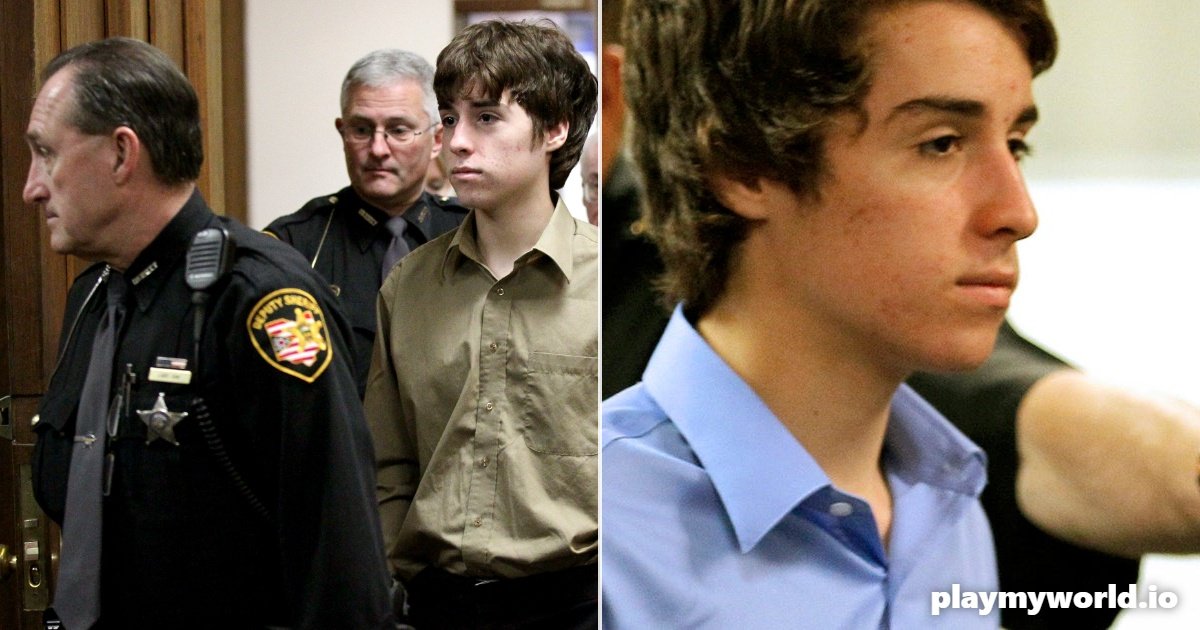
On an ordinary winter morning in 2012, a quiet teenager walked into a high school cafeteria in northeast Ohio and, within moments, shattered an entire community. Thomas Michael “T.J.” Lane III was only seventeen years old when he opened fire on his fellow students, killing three and wounding three others. In the years that followed, his name became synonymous not only with the tragedy itself but with the chilling absence of remorse he displayed in court. More than a decade later, people continue to ask who he was, why he did it, and what has become of him. This article tells the full story of T.J. Lane, from his troubled childhood to the crime that defined him, and finally to where he sits today.
Who Is T.J. Lane?
Thomas Michael “T.J.” Lane III was born on September 19, 1994, and grew up in and around Chardon, a small, close-knit town roughly thirty miles east of Cleveland, Ohio. To most people who crossed his path, Lane appeared unremarkable and withdrawn. Former classmates later described him to CNN as reserved and quiet, a boy who kept to himself, avoided clubs and cliques, and rarely spoke about his personal life. Some remembered him as a normal, even kind, teenager, while others recalled that he often seemed to carry a certain sadness in his eyes. That unassuming exterior would make the violence he unleashed all the more shocking to those who thought they knew him, and it left investigators and the public struggling to understand how such an outwardly ordinary young man could commit an act of such brutality.
A Troubled Childhood and Family Background
Beneath Lane’s calm surface lay a deeply unstable home life. According to reporting drawn from Ohio corrections records and multiple news outlets, his father, Thomas Lane Jr., had a long history of violence and spent much of his son’s childhood cycling in and out of prison, including for acts committed against women. Lane’s mother also faced arrests tied to domestic incidents. This turbulence eventually cost his parents custody of him, and he was raised largely by his grandparents, Jack and Carole Nolan, with whom he was living at the time of the shooting. At that point Lane was not even enrolled at Chardon High School; he attended Lake Academy, an alternative school for students who had struggled in traditional settings, and simply rode a bus that stopped at Chardon, the same route used by several of the students he would later attack.
The Chardon High School Shooting
The morning of February 27, 2012, began like any other Monday. Students filtered into the Chardon High School cafeteria before the first bell, gathering at long tables to talk and wait for classes. At around 7:30 a.m., that quiet routine dissolved into terror. Lane entered the cafeteria carrying a .22-caliber handgun and a knife, approached a table of students, and began firing at close range. Investigators later said he fired roughly ten rounds. As panic spread and students dove for cover, Lane moved through the room and, while fleeing the building, shot a female student as well. Six students in total were struck. His rampage ended when a teacher, Joseph Ricci, and the school’s coach, Frank Hall, chased him out of the building. Lane was arrested a short time later by police near his car, parked just outside the school grounds, bringing a horrifying few minutes to a close but leaving lasting devastation behind.
The Victims and Survivors
Any account of this case must remember the young people at its center. Three students died of their wounds within two days of the shooting: sixteen-year-old Daniel Parmertor, seventeen-year-old Russell King Jr., and sixteen-year-old Demetrius Hewlin. Three others survived but bore the scars of that morning. Nick Walczak, then eighteen, was shot multiple times and left permanently paralyzed from the waist down. Nate Mueller suffered a comparatively minor injury, and Joy Rickers, the student shot as Lane fled, survived her wounds. In the years since, several survivors have transformed their pain into purpose, becoming advocates for school safety and violence prevention. Coach Frank Hall, who chased Lane from the school, went on to found a foundation that helps survivors share their stories in schools around the country, insisting that the names remembered be those of the victims rather than their killer.
Arrest, Charges, and Guilty Plea
Because Lane was seventeen at the time of the killings, he was initially held as a juvenile while prosecutors decided whether he should be tried as an adult. Given the gravity of the crime, that decision came quickly, and he was charged as an adult and indicted on three counts of aggravated murder, two counts of attempted aggravated murder, and one count of felonious assault. On February 26, 2013, nearly on the one-year anniversary of the attack, Lane pleaded guilty to all charges, ensuring there would be no trial. One point often misunderstood about the case is worth clarifying: Lane never faced the death penalty. Because he was a minor when he committed the crime, capital punishment was legally impossible, and the harshest sentence available to the court was life imprisonment.
The Infamous Sentencing
On March 19, 2013, Lane appeared in a Geauga County courtroom for sentencing, and what unfolded there turned a tragic case into a national symbol of cold-blooded cruelty. As the hearing began, Lane unbuttoned his dress shirt to reveal a plain white T-shirt underneath with the word “killer” scrawled across the front. Then, as the families of his victims sat only feet away, some describing him as a monster, he smirked, raised his middle finger toward them, and delivered a short, profane statement mocking their grief. He offered no apology and showed no trace of remorse. The display was so disturbing that the court later issued a statement acknowledging that, however reprehensible his conduct was, he retained a legal right to speak at sentencing. The judge imposed three consecutive life sentences without the possibility of parole, one for each life he had taken, along with additional time for the other counts, effectively guaranteeing that Lane would spend the rest of his life behind bars. His attorneys later appealed, arguing that life without parole was unconstitutional for a juvenile offender, but an Ohio appeals court denied the challenge and the sentence stood.
The 2014 Prison Escape
Lane’s story took a dramatic turn on September 11, 2014, when he escaped from the Allen Correctional Institution in Lima, Ohio, where he had been held in protective custody. According to a report from the Ohio Department of Rehabilitation and Correction, Lane and two other inmates had spent months secretly constructing a makeshift ladder, roughly thirteen feet tall, from materials gathered in a crawlspace near the recreation yard. Using it, the trio scaled a fence and crossed the roof of an entry building before fleeing into the night. The escape triggered a massive manhunt and gripped the Chardon community with fear, prompting officials to close the high school the following day. The freedom, however, was short-lived. Lane was recaptured within about six hours, found hiding near a church only a hundred yards or so from the prison. The breakout led officials to discipline several employees for security lapses and, most significantly, to move Lane into far more secure confinement.
Where Is T.J. Lane Now?
Following his escape, Lane was transferred to the Ohio State Penitentiary, the state’s supermax facility in Youngstown, where conditions were dramatically more restrictive. There, inmates are held in small cells, largely isolated from one another, and monitored constantly. Officials explained at the time that the severity of his crimes, combined with threats other inmates had reportedly made against his life, warranted placing him at the highest security level. In the years since, Lane has been reported at more than one Ohio facility as corrections officials managed his housing, and because inmates are periodically transferred, the state’s official inmate records remain the definitive source for his exact current location. What is clear is the bottom line: as of 2026, T.J. Lane is thirty-one years old, still alive, and still incarcerated within the Ohio prison system under a sentence of life without parole. He has no release date, and barring an extraordinary legal reversal, he is expected to die in prison.
Conclusion
The Chardon High School shooting remains one of the most painful chapters in recent American memory, remembered as much for the senselessness of the violence as for the defiance of the young man who caused it. T.J. Lane offered the world no clear motive and no apology, leaving behind grieving families, wounded survivors, and a community forever changed. Yet the lasting legacy of that February morning belongs not to Lane but to the three students whose lives were cut short and to the survivors who chose to build something meaningful from their suffering. As Lane sits in a prison cell with no prospect of freedom, the enduring lesson of his story is a reminder of how much can be lost in a single moment, and how a community can still choose to honor the lives that were taken.
You May Also Read :Fotis Dulos